

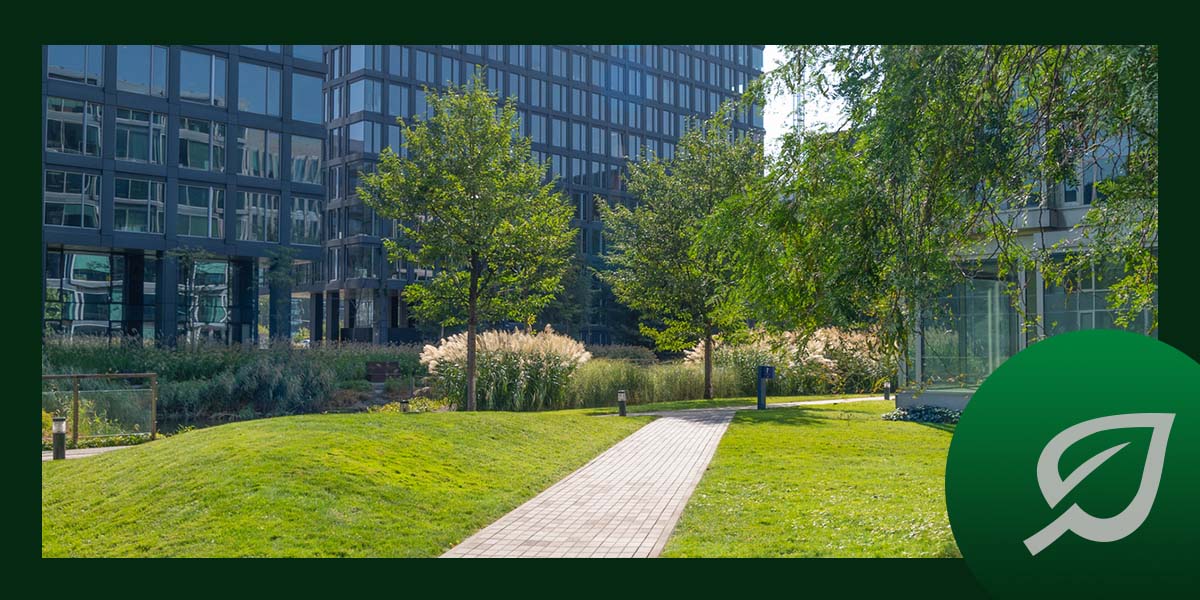
Sustainable landscaping can positively impact operational costs, risk, leasing, and sale price. For commercial properties, it can do exactly that when it’s designed with performance in mind, not just aesthetics. Planned properly, landscaping can deliver a practical set of wins for owners and asset managers.
Below, we examine sustainable commercial landscaping benefits and how they translate into commercial landscaping ROI for properties in Massachusetts and Virginia.
Stormwater Performance and Site Resilience
In simple terms, stormwater-first landscaping means you decide what happens to the water before it hits the ground. It has a planned route and a planned destination. You slow it down so it doesn’t tear up beds and edges, keep it away from doors and loading bays, and shape the site so most of the work is planned maintenance. It’s one of the easiest benefits to justify because it cuts repeat spend and helps keep the site steady over time.
In both Massachusetts and Virginia, formal guidance pushes property owners toward better stormwater practice. The Massachusetts DCR Stormwater Design Handbook promotes site designs that slow, store, and treat runoff using green infrastructure where appropriate. The Virginia Stormwater Management Handbook has a similar emphasis on improving the design, construction, and maintenance of stormwater infrastructure to protect surface water quality.
The guidelines reflect each state’s unique challenges. Sustainable commercial landscaping in Massachusetts must handle harsh winters and road salt exposure, while Virginia properties face intense summer storms and clay soil drainage issues.
For investors, this matters because recurring drainage failures are now easy red flags. Buyers might not expect perfection, but they do pay attention if a property has a known drainage headache that will eventually require a six-figure fix. That has a direct impact on commercial property value factors in MA and VA.
Lower Cooling Demand and More Comfortable Hardscape
Landscaping can reduce cooling demand by lowering surface temperatures and shading building surfaces. The best public benchmark comes from the EPA, which notes that trees and vegetation can reduce heat island impacts and, in some contexts, reduce nearby building energy demand by around 10%.
You won’t see the same savings on every property. Energy impact depends on building orientation, glazing, HVAC design, and whether shade actually lands where it matters. But on many commercial sites in MA and VA, it’s a credible lever when applied properly.
This strategic placement of shade and cooling vegetation tends to translate best on properties with heavy afternoon sun, large paved areas like parking and loading zones, and exposed entry routes. In landscape design for corporate campuses, “strategic” usually means shade is positioned to cool the hottest pavement. It can also improve comfort on popular routes and reduce heat gain near the building envelope. That’s a practical way to reduce operating costs without touching mechanical systems.

Better Rent Pricing and Stronger Property Value
A green, well-kept outdoor space isn’t just “nice.” It increasingly appears in the data on what tenants and buyers are willing to pay.
For example, a study of New York City offices used Google Street View to measure “street-level greenness” and found that buildings with more greenery commanded an 8.9%-10.5% transaction price premium and a 5.6%-7.8% rent premium compared with offices in very low-greenness locations.
These aren’t MA- or VA-specific numbers, but they give executives a useful benchmark in understanding how the outdoor space can be designed as part of the asset, showing up as higher rent pricing, better retention, and more resilient exit values.
More Predictable Maintenance and Irrigation Costs
On many commercial sites, a large share of the landscape budget is spent on the same fixes, and it shows up as noise in the operating account. Sustainable design aims to reduce those expenses by matching the plan to real site conditions from the start.
Plant species are chosen for the specific conditions in each area rather than from a generic list. High-input turf is used only where it clearly supports the brand or use, rather than everywhere by default. Soils are improved before planting, and drainage is fixed early rather than after repeated failures. Irrigation is divided into zones by plant type and exposure, and on larger sites, smart controls and better monitoring help reduce waste.
Essentially, a planting scheme that fits the site and is backed by proper water management needs far less corrective work.
Reduced Insurance Costs Through Risk Mitigation
Slip and fall claims are one of the most common causes of commercial liability pay-outs in the U.S. Insurers repeatedly highlight wet, uneven, or poorly drained surfaces as key risk factors.
Sustainable landscape design targets these issues directly. It naturally improves drainage so water doesn’t sit at doorways or along main walkways, stabilizes slopes and edges, and keeps routes clear, obvious, and well-lit so people don’t cut through unsafe areas.
The result is fewer slips, trips, and minor flood incidents over time, improving your loss history. Better loss history supports stronger terms and makes it easier for your insurer to view the site as a well-managed risk.

Contact Greenscape for Sustainable Commercial Landscaping in Virginia and Massachusetts
Greenscape helps commercial properties use sustainability as a practical performance upgrade. This process involves designing and maintaining landscapes that handle water better, stay healthier with fewer inputs, and reduce the kind of recurring failures that inflate operating budgets over time.
Our sustainability approach is built into how we operate, from smart irrigation and water management to expanding the use of electric equipment that cuts emissions and significantly reduces noise on occupied sites.
If you’re looking at your next budget or planning improvements, our team can walk the site with you, show you where money is being lost to repeat fixes, and build a simple phased plan so eco-friendly landscaping benefits turn into real ROI and long-term asset value.
Contact Greenscape to learn more about how we can support your property.
Links:
- https://www.mass.gov/info-details/dcr-stormwater-management
- https://www.deq.virginia.gov/water/stormwater/stormwater-construction/handbooks
- https://www.epa.gov/heatislands/benefits-trees-and-vegetation
- https://www.greenscape.us.com/who-we-service/commercial-landscape/
- https://www.sciencedirect.com/science/article/abs/pii/S0169204621001250?
- https://www.greenscape.us.com/who-we-service/urban-commercial-landscaping/
- https://www.insurancejournal.com/news/national/2025/12/10/850545.htm
- https://www.greenscape.us.com/who-we-are/sustainability/
- https://www.greenscape.us.com//contact-us/